
The Exiles (1961) Introduction
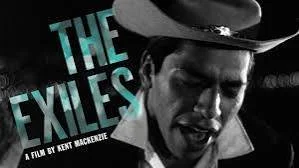
Good evening, and welcome to tonight’s screening of Kent Mackenzie’s The Exiles.
There are many circumstances that can lead to a film being forgotten. Sometimes it’s a matter of physical inaccessibility. Sometimes a misunderstanding of a film’s value can lead to a lack of appropriate distribution efforts. Sometimes the formal or thematic qualities of a film are so far ahead of their time that a film can be isolated in the era in which it’s produced in. The Exiles is a film which experienced all three of these circumstances.
Whilst studying at the University of Southern California, British-born Mackenzie directed his graduation film Bunker Hill 1956, a short documentary, about the aged residents of the titular neighbourhood. Formerly the richest neighbourhood in LA, it was then a near-slum. Whilst living and working in Bunker Hill, Mackenzie met a group of Native Americans and started hanging around with them, at the bars and parties. The relationships and experiences made in this period went on to form the basis of tonight’s film. The story of one night in the lives of a group of Native American men and women living in downtown Los Angeles.
The film is a fascinating hybrid of narrative and documentary. The principle characters, Homer, Tommy, Clifford and Yvonne all bare their own names. The narration was comprised from audio interviews conducted with the actors out of character, sharing details about their own lives that then informed the nature of their “fictional” selves. These interviews offer glimpses into the melancholy that lurks under this film’s surface. Beneath the recklessness and bravado of youth, there is pain. A pain that these young people don’t know how to articulate to each other. In this way, these interviews take on a confessional quality. The characters share their desires, their insecurities and their sadness, not with each other, but with us.
When asked about his involvement in the story, MacKenzie admitted to getting a little closer to his subjects than an objective documentarian should / drinking and playing cards, but also discovering limits of integration, as when he found himself “cornered against bar-rails and men’s room walls and forcibly instructed as to what had happened to General Custer at Little Big Horn.”
The film became the stuff of legend at USC, at least partially due to the hectic nature of it’s production. The film was shot over three-and-a-half years, on borrowed equipment, with the cast often receiving food or alcohol in lieu of payment. Of the six actors who appear in the opening scene, three were jailed before the second shooting session, and so never reappear. Others cast members left town to dodge the law, some were jailed on essential shooting days, others just vanished. Maintaining continuity was reportedly a nightmare. MacKenzie described that ‘Character’s facial features were altered by fist-fights, their costumes were ripped apart in brawls or stolen while they were drunk”. What’s more, there are three credited cinematographers on the film, after MacKenzie lost the first two cameramen to military conscription. It’s a miracle that the film’s visual style is even coherent. But as I’m sure you’ll appreciate, the richly defined shadows of the night-time photography, look glorious restored in 35mm. The film’s aesthetic qualities, which occupy a halfway house between 1940’s Hollywood Noir and the New American Cinema movement of the late 60s and 70s, are one of the many reasons we feel the film is worth celebrating.
The Exiles premiered at Venice Film Festival in 1961, where it was bought by a U.S distributor, but was only licensed in a 16mm version for schools and churches. It received no theatrical release at the time, and thus fell into relative obscurity. It’s been screened often for USC students and faculty, but has had little life beyond that context. This was until, in 2008 it was restored by the UCLA Film and Television archive. In collaboration with Milestone, the film was re-released, both on DVD and a 35mm print which debuted at Berlin in the same year. It is through that restoration that we are able to share the film with you tonight.
It’s confusing that a film deemed “culturally, historically and aesthetically’ significant enough to be added to the Library of Congress just a year after it’s re-release, could have been so unseen and unappreciated for nearly 50 years. David James, Professor of Critical Studies at USC, identified two potential reasons for it. Firstly, he suggested that The Exiles worked in a documentary style that was soon to become obsolete. The film, Quote “was poetic, visually striking, great 35mm stock. But around this time, cinema verité was coming in: 16mm, handheld, sync sound, and instead of prizing visual appearance, filmmakers were now prizing authenticity and non-intervention, so this kind of documentary was discredited”.
As for his second reason, James continues “By the beginning of the next decade, (referring to the 70s), the civil rights movement had entered into film culture and minority peoples had started demanding the right to represent themselves. So the idea of a white male representing Native American people was discredited”. These are discussions that we have seen resurface this year around the release of Martin Scorsese’s Killers of the Flower Moon.
I personally am not convinced by either of these reasonings. Does a film’s visual style have to compromise it’s authenticity? Does the colour of a filmmaker’s skin restrict the film from being able to capture something true? There are, of course, no correct or easy answers to these questions, which is perhaps appropriate, given that The Exiles itself offers no easy answers.
The docu-fiction nature of The Exiles lends the film an ethnographic quality, a piece of “Native-Americana”. The neighbourhood of Bunker Hill no longer exists. Almost all of the principle characters died young, around and even during the time of film’s production. But their lives, their cultures and their histories live on in this film. This context adds a further resonance to it’s imagery. Acts like Rico writing his name in chalk on the side of the underpass, a small act of defiance that becomes a symbol of an unexpressed desire, to leave a mark on a town that’s already forgetting you.
I’d like to leave you with a quote from critic Ann Hornaday, who in her review in the Washington Post called the film “A fascinating hybrid of art and life. It may not hew entirely faithfully to literal truth but nonetheless conveys a form of artistic honesty that is inescapable. A mesmerising marriage of prose and poetry.”
Thank you very much for listening and I hope you enjoy the film.