
‘Run Lola Run’ (1998) Introduction
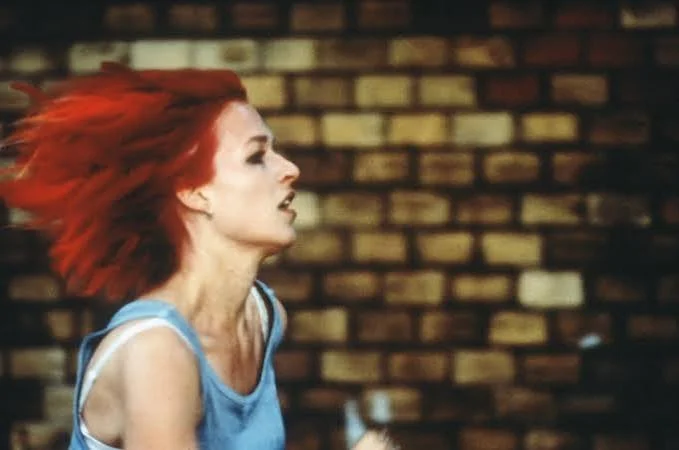
Run Lola Run is a really interesting choice for today’s theme. When I was considering the prompt of Non-linear, my mind was consistently drawn to Noir and detective films, which often utilise flashbacks or memories to obscure information from the audience to make the mystery more compelling. But Tom Tykwer’s 1998 action-thriller takes the opposite approach. It’s use of non-linear narrative structure is made very apparent and very plain. It’s ‘in-your-face’, which is a fair description of the film as a whole.
The film centres on Lola, played by Franke Potente, who receives a panicked call from her boyfriend Manni. He has misplaced 100’000 Deutsche Marks belonging to a “very bad guy”. With just 20 minutes to find the money and save Manni’s life, Lola is thrust into a high-stakes, high-octane chase across Berlin. The 20 minute window plays out 3 different times, 3 different ways, allowing the film to play with themes of chance, fate and the application of chaos theory.
Nowadays Tykwer is best known for his collaborations with the The Wachowski’s, co-directing their sci-fi epic Cloud Atlas, co-creator of German Television series Babylon Berlin, as well as part of the huge ensemble of directors assembled for 2006's Paris Je T’aime, in which he directed segments of an anthology alongside everybody from the Coen Brothers to Gérard Depardieu. But it was Run Lola Run, his third feature, which launched his career on the international stage. The film played in competition at Venice, having won the Audience Award at Sundance earlier that year. Writing for Time Out, Howard Feinstein described him as “The most promising German filmmaker since Fassbinber!”. This definitely feels like an unenviable position to be put in as a young director, though, I think it’s clear to see where that excitement was coming from, as Run Lola Run boasts an infectious energy.
Tykwer has spoken openly about his affection and admiration for Polish director Krzysztof Kieślowski (he even stepped in to direct Heaven (2002), a script Kielślowski had written but passed away before having the chance to film). Like Run Lola Run, The Double Life of Veronique (which we watched earlier this year) and 1987’s Blind Chance both explore how small choices can have big consequences. But despite their thematic connections, their technical approach couldn’t be further apart.
Dynamic camera movements, animated segments, and a general business all contribute to what is a very maximalist film, and a stark contrast to the work of many of Tykwer’s contemporaries of European cinema in the 90s. If you were to categorise Kielślowski as Slow Cinema, then Run Lola Run is FAST.
Tykwer is known to take a very hands on approach to filmmaking. As well as a writer/director, he has been composer on many of his projects. His collaborations with Johnny Klimek and Reinhold Heil is one of the strongest strings to this film’s bow. The thumping techno soundtrack plays a huge role in creating the drive and verve with which this film moves.
The films plays fast and loose with it’s narrative structure, as well as the geography of Berlin. Eagle-eyed viewers have remarked that the distance between Lola’s apartment and the street corner where she’s supposed to meet Manni in 20 minutes are 6km apart. But I think that serves as a testament to the physical commitment of Potente’s performance. She is truly giving Tom Cruise a run for his money with the amount of distance she covered in this film, all while in Potente’s words “running in Doc Martens and smoking two packs a day”.
An element of the film that encourages discussion is Lola’s role as an action heroin. The iconography of her scorched red hair and sleeveless vest might convey a certain archetype. But it’s Lola’s quote-unquote “normality” that make her such a compelling character. Potente has spoken in interviews about they wanted Lola to look like a real person and not an athlete, saying “I’m not a runner. Never was. Never will be.” Having a normal protagonist thrust into an extreme situation is effective way to raise the stakes and the tension. Some writers have argued that for a character with so much agency, in that the whole narrative lives and dies by her decision making, the film’s ending “fails” Lola as a character, which I’d be intrigued to hear your thoughts about after.
Other cynics have commented on the simplicity of it’s genre thrills. Critic Jonathan Rosenbaum of the Chicago Reader called the film “About as entertaining as a no-brainer can be”. But I think in many ways, the film is unapologetic in it's simplicity. It’s the kind of film that does exactly what is says on the tin. It’s kinetic, it’s dynamic, it’s frantic. It’s all the words than end in ‘ic’. And I hope it should be some good fun to end the day with.