
‘The Blue Caftan’ (2022) Review
Sensuality is called into question from the opening frames of Maryam Touzani’s The Blue Caftan. The opening credits play over a striking montage of a blue fabric. The way the camera interacts with the material, rising and caressing around it’s curves and folds, provokes a powerful feeling of longing. The fabric feels unidentifiable, yet familiar. It is desirable, but unattainable. These conflicting emotions exist in balance with each other. A balance that epitomises the relationship of Halim (Saleh Bakri) and Mina (Lubna Azabal), who’s married life exists in a fragile state between stability and the verge of collapse.
At first glance, Mina and Halim’s marriage appears to be loveless. The richness of the opening makes way to a palpable lack of intimacy between the pair. They communicate more through nods and looks than spoken word. Their conversations are often cut between mid shots, with the two rarely sharing the same frame. Typically of Touzani’s work, intimacy must be projected onto every day activities to fill the void left by her protagonist’s inabilities to communicate or act upon their feelings. In her tender two-hander Adam (2019), kneading dough was the stand in. In The Blue Caftan, even the simple act of washing is rendered as sensual, through crisp sound design and close-ups that are almost uncomfortably so.
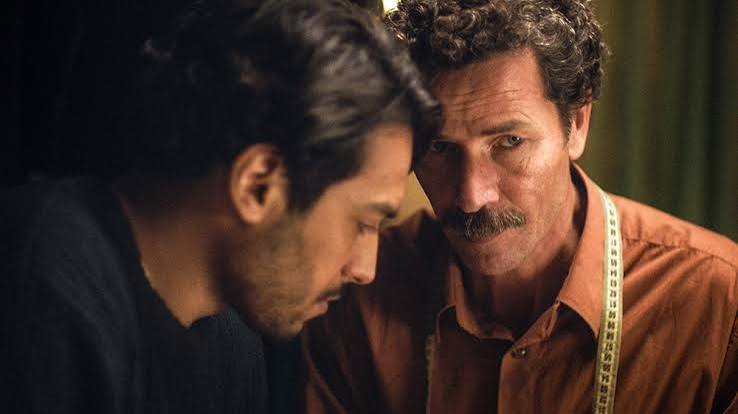
Halim’s true passion, it seems, lies with his work. A maalem (tailor) of some renown, the film takes great pleasure in indulging in the artistry of Halim’s craft. The tactility in the film’s soundscape, the gentle bristling of the thread providing a contrasting stillness amidst the bustling streets of Salé, infers a real mastery. The years of training are felt in the very precision of his work. Halim feels it crucial that this training should be passed down to future generations. Youssef (Ayoub Messioui), it turns out, is the latest in a long line of apprentices that Halim has taught. Mina doesn’t share this sentiment. “No one”, she says, “wants to learn the craft anymore”.
The couple’s conflicting relationship with the past extends beyond their work. Halim has a more romanticised nostalgia for the way that things were. Mina, as perhaps an extension of her increasing memory loss, has a more cynical view. A memorable scene in which the couple observe a funeral procession go by under their window sees Mina scorn at how the modest arrangements couldn’t live up to the memory of the person, “I’m sure she dreamed of something else”. While at odds with each other, Halim and Mina are like the stitching on the titular garment. Their lives are lines that run parallel to each other, rarely allowed to meet.
But loveless is too reductive a characterisation for the complexity which Touzani imbues her characters with. Despite their clashing viewpoints, they are a constant in each other’s lives. Mina is first to his aid when a customer starts to criticise Halim for not working fast enough. Their nods and glances are as much an illustration of a communicative shorthand acquired through years of time spent together as they are a lack of physical intimacy. It’s testament to the beautifully restrained performances of Bakri and Azabal that the thread of affection is allowed to shine through only on the rarest of occasions. One such occasion sees the two walking arm in arm returning home from a cafe, only to be interrupted by a ‘routine’ police check, a comment on how a culture of surveillance, in which a marriage must come with the required documentation, inhibits and restricts people’s abilities to love one another freely.
The presence of Youssef serves as the catalyst to start breaking down those restrictions. Youssef represents a cultural, generational difference. He is able to proclaim his adoration for Halim with relative ease, a stark contrast to the whispered interactions of Halim and Mina. Whilst his hiring is initially just another point of contention between the pair, his growing presence in their lives initiates a change in both Halim and Mina. As Mina’s health begins to deteriorate, the two are finally able to reach a common ground, finding the space to talk about and ultimately make peace with the secrets they had sworn to never acknowledge. As Halim washes Mina’s hair, the most touching act of physical intimacy in the film, Mina questions why Halim had never done so before. “You only had to ask” he replies. Herein lies The Blue Caftan’s real tragedy. Two lovers only finding the way to express their feelings once it is too late.