
‘A Matter of Life and Death’ (1946) Introduction
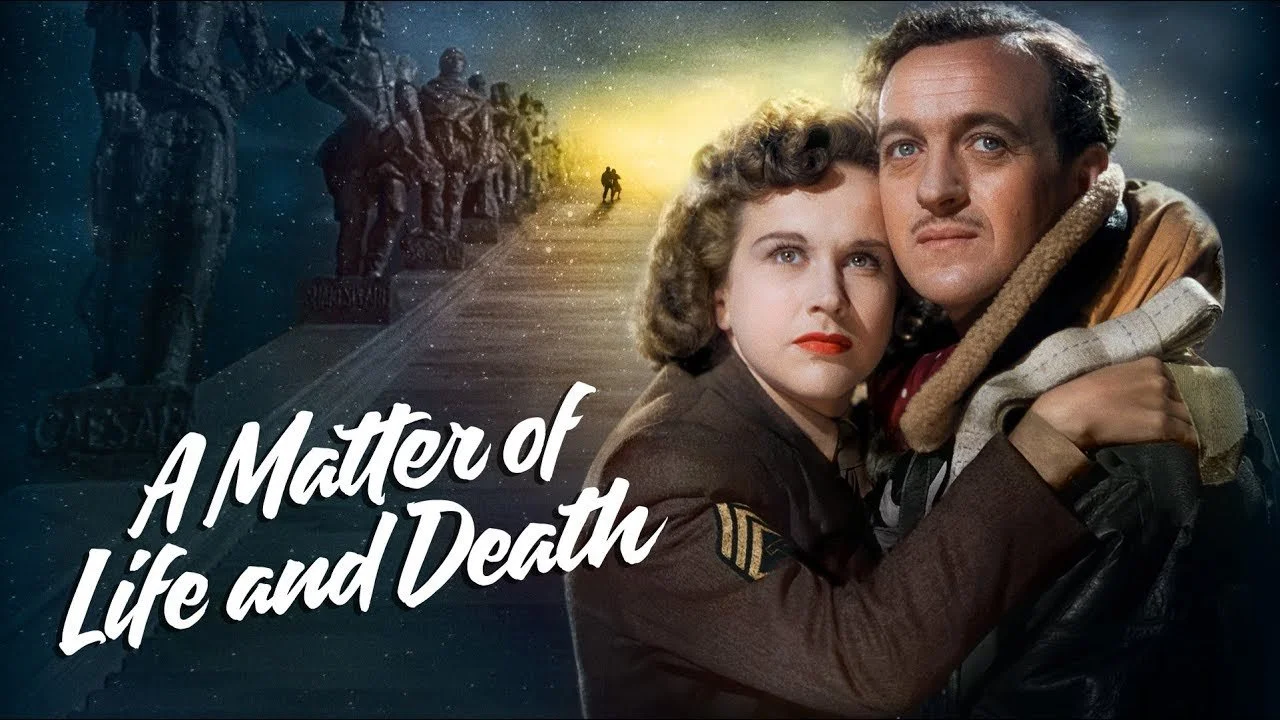
Introduction for Michael Powell and Emeric Pressburger’s A Matter of Life and Death (1946), delivered before a screening at Genesis Cinema on the 10th of November 2024.
Good evening everyone. Welcome to Genesis Cinema and tonight’s screening of A Matter of Life and Death. My name is Archie Marshall, I’m a Curation and Programming student at the National Film and Television School and curator of the season ‘BEYOND - Visions of the Afterlife’, which tonight’s screening is the closing night of.
Across the season, we’ve strived to celebrate the craft and creativity required to visualise the afterlife on screen, and there are few films which boast the level of visual artistry that A Matter of Life and Death does.
When a young RAF pilot (David Niven) cheats death after bailing out of his aeroplane without a parachute, he falls in love with an American radio operator (Kim Hunter). Realising their mistake, officials from ‘the other world’ send an angel to collect him and bring him before a a celestial court to argue for his life.
Cinematic magicians Michael Powell and Emeric Pressburger were operating at the peak of their powers in the 1940s. During a run that produced such classics as The Life and Death of Colonel Blimp, A Canterbury Tale, Black Narcissus and The Red Shoes, the pair were approached by the British government to make a film that might improve relations between the British public and the American soldiers stationed in the UK. Beyond the initial conception, the pair rejected both the funding and notes of the government. Going against the grain of the gritty, realist war films of the period, the duo instead created a timeless romantic fantasy which has become synonymous with the directors’ heart, wit and technical ingenuity.
In America, the film was originally retitled to ‘Stairway to Heaven’ as the studios thought a film with ‘death’ in the title would be rejected by audiences still reeling from the lasting impacts of World War II. However, it seems that film’s directness was a source of comfort for audiences, as amongst the comedic and fantastical moments, there is a very earnest, end-of-war reflection on the living and the dead, including those who had been missing for a time, stranded in between.
The contrasts and ultimate connections between the film’s two worlds are highlighted by their respective colours palettes. Life on Earth is shot in gorgeous 3-strip Technicolour, whilst their afterlife is in monochromatic black and white. The Wizard of Oz was the natural blueprint for this, but Powell and Pressburger were insistent on the reverse effect. The beautiful, modernist designs of the ‘other world’ (carefully never referred to as heaven) provide great spectacle. But it’s in the rich and vivid colour of Earth where the film’s celebration of life is most felt, which you’ll hear Marius Goring’s Conductor 71 remark upon shortly.
I personally cannot wait to see this film on the big screen again. From the largest canvases, like the building the full escalator set (which stood at 20 feet wide and 106 steps tall), to the smallest of minutia, like cinematographer Jack Cardiff breathing on the camera lens to give the beach landing sequence a more etherial look, it truly feels like every frame of the film is presenting it’s own great innovation. I have no idea how some of these shots and sequences were pulled off, which I feel only adds to the mysticism and immense creativity of the film.
Upon it’s release in 1946, some critics were somewhat bemused by the film’s mix of melodrama, romance and end-of-war spectral visions. The film is undeniably an oddity. But in time, A Matter of Life and Death has gained a reputation as one of the great British films. It’s become a mainstay on Sight and Sound’s Top 100 Films lists, and is consistently referred to as a favourite by other filmmakers. Not least Martin Scorsese, one of the great champions of Powell and Pressburger’s career, who described the film as ‘unique and audacious picture which makes a stand for love surviving and conquering all’.
I must say a quick thank you to Genesis cinema for being the generous hosts of this season, and to Park Circus for supplying us with the copy of the film to watch tonight. If you do like what you see tonight and have any thoughts on the film or feedback on the season, whether tonight is your first screening or your 4th, I’ll be around in the lobby after the film, so please feel free to come say hi and share any thoughts or feelings you might have.
But with all that said, thank you very much for listening and I hope you enjoy the film. Cheers.