
‘No Bears’ (2021) Introduction
Hi everyone. For those who don’t know me, my name is Archie. I’m a 2nd year curation student, and it’s a pleasure to be here introducing No Bears for you today.
This morning we’ve taken a look at examples of banned and blacklisted art. But now we’re turning our attention to what happens when the artists themselves are banned.
Filmmaker, screenwriter and editor Jafar Panahi has been credited in playing an influential role in the Iranian New Wave. Having cut his teeth on short films and working as an assistant director for fellow Iranian filmmaker Abbas Kiarostami, he came to prominence with his debut feature The White Balloon in 1995. The film received the Camera d’or at Cannes, becoming the first Iranian film to win a major award at the festival. The prize turned out to be the first in a long line of critical and festival praise in Panahi’s early career, with each of his next 3 features winning a major prize in Locarno, Venice and Berlin respectively.
Despite being showered with international praise, Panahi has always has a troubled relationship with his home country. His films are known for their humanistic perspective on life in Iran, often focusing on the hardships of children, the impoverished and women. His openly critical depictions of the government have frequently landed him trouble with the state. Despite all of the acclaim and accolades he received, his work was consistently banned in Iran, which as we’ll see later only adds to their potency. Hamid Dabashi, professor of Iranian Studies at Columbia University has written that ‘Panahi does not do what he is told - in fact he has made a successful career out of not doing what he is told’.
After 15 years of conflict with the Iranian government about the content of his films, including his work being frequently banned from screening in Iran and several short terms arrests, the state escalated their suppression of Pahani’s voice. In March 2011, while at dinner, Panahi was arrested along with his wife, daughter and 15 friends, charged with propaganda against the government. Despite support from filmmakers and human rights organisations around the world, in December of that year Pahani was sentenced to 6 years in prison, and a 20 year ban on making films. He was forbidden to direct, write screenplays or give interviews to any Iranian or foreign media / He was, in fact, only permitted to leave Iran for medical treatment or to make pilgrimage to Mecca. It was feared at the time that this verdict would spell the end for one of Iran’s most significant directors.
In the 12 years since his ban, however, Panahi has made more films that he did in the 15 years prior. From 2011’s This Is Not A Film, a documentary/video diary shot entirely within his house while awaiting the result his trial to 2015’s Taxi, a docufiction in which Panahi mascarades as a taxi driver in order to conduct interviews with people about the state of life in Iran, Panahi’s career and work has only been emboldened by the ban. His work is a testament to the idea that the presence of restrictions can inspire creative solutions, a sentiment that has been echoed by many Iranian filmmakers trying to operate under the regime. This includes Samira Makhmalbaf, director of 1998’s The Apple, who said that “Problems don’t always make you think smaller - limitations make you think harder.”
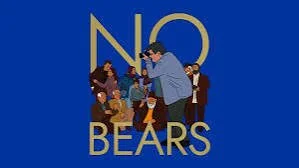
Which brings us to No Bears. Shot secretly and illegally in Iran, as all of his films since 2010 have been, No Bears sees Panahi playing a version of himself / He has rented a room in the village of Jaban, near the border with Turkey, to remotely direct a film about an Iranian couple attempting to secure fake passports so they can flee the country. As the shoot and his stay drag on, his relationships with his crew and the village locals start to boil over.
The film debuted at the Venice film festival in September 2022, yet again to great acclaim. New York Times Critic Justin Chang declared it the best film of 2022, stating “Part of the point Panahi is making in this movie is that his constraints have never been purely physical, and neither are his means of resistance. Cinema, like the world itself, is full of invisible boundaries, governed by rules and assumptions that Panahi has long challenged with extraordinary resourcefulness and good-natured cunning.
Just a few months prior to it’s release, Panahi had been sentenced to a further 6 years in prison for the production of this film. After the film won the Special Jury Prize at Venice, the Ministry of Culture in Iran called the film “a political game rather than a movie”.
Panahi has always managed to meet the resistance to his work with good humour. There are infamous stories like the filmmaker smuggling This is Not a Film out of Iran on a USB stick hidden inside a cake, or his daughter Solmaz accepting his best Screenplay award at Cannes 2018 on his behalf, delivering a brilliantly in-your-face statement which I highly recommend you track down on Youtube. But there is also a concern that this continued act of defiance won’t be allowed to continue forever. Upon the release of No Bears, Indiewire’s David Ehrlich wrote ‘the run of films Jafar Panahi has made since receiving his 20-year ban remains one of the great miracles of modern cinema, and I hope that it isn’t over yet.” When each and every film made is act of anarchy, there is a real jeopardy that each and every film might become his last. Which makes celebrating the creativity and resilience of work like No Bears all the more important.
There’s so much to unpack about No Bears, in the way that it’s blend of narrative and non-fiction makes it difficult to identify where the sub-text ends and the context begins. I’m going to leave most of that unpacking to all of you, so I think there’s nothing more to say except “Free Jafar Panahi” and I hope you enjoy No Bears.