
‘The Gleaners and I’ (2000) Introduction
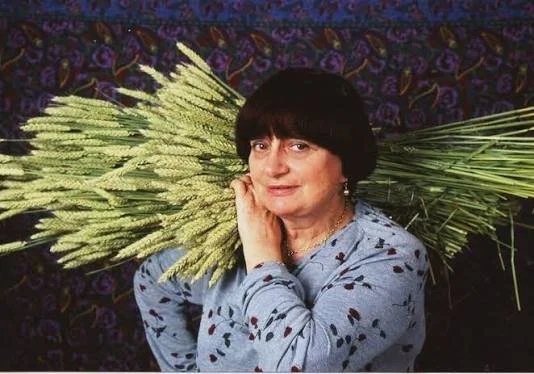
Good evening everyone. Welcome to the Cine Lumiere. My name is Archie Marshall. I’m a film curator & programmer, and it’s a pleasure to be able to welcome you to tonight’s screening as part of our retrospective season ‘Agnes by Varda’. Until now, our season has focused primarily on Varda’s narrative films, but tonight we turn our attention to her documentary work, with the poetic and humanist The Gleaners and I.
On the brink of a new millennium Agnes Varda, the pioneering “grandmother of the new wave”, embarked on a year long journey across Southern France, to document the lives of the modern day ‘Gleaners’. At it’s core, Gleaners explores the age-old practice of gleaning - the act of gathering the left over crops from farmers fields. But Varda’s lens expands far beyond these fields, capturing the stories of urban gleaners who salvage discarded goods from bins and city streets. Through their eyes, and hers, we witness the resilience of those who live on the margins of society, finding value and purpose in what others cast aside.
One of the numerous traits that set Agnès Varda apart as a filmmaker was her ability to infuse her documentaries with a deeply personal touch, as seen especially in later works like Jacquot de Nantes and Faces Places. As the title The Gleaners and I might suggest, she not only shines a light on the lives of others but also her own, sharing intimate reflections on aging, mortality, and the passage of time. Through her candid self-portraits and playful narrative asides, Varda blurs the line between observer and participant, as no matter how objective she tries to remain, it’s an impossible task to stop her personality and charisma shining through.
In a similarly meta-textual fashion, Gleaners also sees Varda exploring her relationship with the medium of filmmaking itself. In many ways, The Gleaners and I is a return to the themes explored earlier in Vagabond, rural poverty and substance living. But Gleaners is given a new lease of life by the freedom and flexibility of the digital camera. Varda’s excitement about the potential of this then new technology is palpable throughout the film. The spontaneity of this device and the endlessly curious eye of a truly philanthropic artist really feel like a perfect match. The scene that stands out to me most has nothing to do with gleaning. As Agnes is driven between locations for interviews, she remarks at the huge lorries that come barging past the car. With the camera in one hand, she reaches out for the trucks, grasping them within her other. It’s a moment of earnest playfulness, made entirely possible by the instantness of digital. She saw an image that compelled her and she captured it.
In an interview with Sight and Sound, Varda remarked on another scene which was a direct result of her digital camera. An early moment sees Varda returning from a trip to Japan and reacclimatising to her apartment. We follow her eye through the camera as she looks round at her cats, her plants and a damp patch on the ceiling that reminds her of an abstract painting. As her eyes continue to wander, she becomes suddenly horrified by the signs of ageing on her hands, remarking about the wrinkles and liver spots. In the interview, Varda explained that “That shot wasn’t foreseen or planned. It happened intuitively. I’d have never been able to do it if I’d had to tell a DP to film my hand. One hand filmed it, the other was the subject”.
The other great strength of the digital camera, for Varda, was the intimacy it facilitated with her subjects. There is nothing that feels staged or rehearsed about any of the interview sequences in Gleaners. Through these candid, fly-on-the-wall discussions, we come to learn about the great breadth of reasons why her interviewees started to glean. Some do it out of necessity, others out of a moral obligation. Some do it purely for the love of it. Remarkably, Varda devotes the same level of intrigue and engagement to them all. When asked about the film, Varda explained that documentary more broadly ‘is a school for modesty, you have to put you artistic ego on hold because you’re at the service of the people you film’. There is no bias or judgement cast, she is simply observing their stories and capturing them, making The Gleaners and I an example of ‘documentary’ in it’s purest form.
It should perhaps be unsurprising that Agnes Varda found such a personal connection to the lives and stories of the Gleaners. As a filmmaker who found beauty in the overlooked and the extraordinary in the ordinary, she had in fact been gleaning all her life.
Thank you very much for listening, and I hope you enjoy the film.